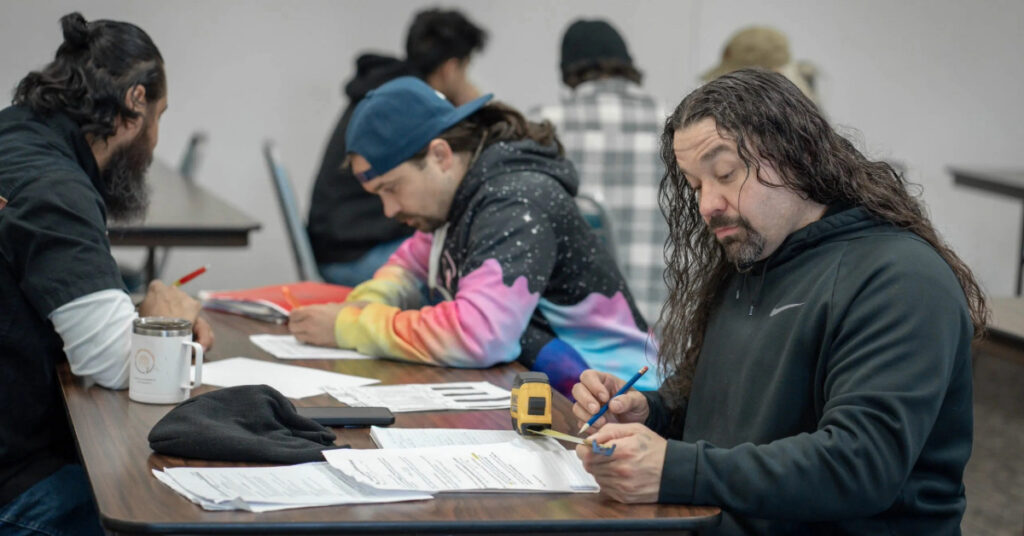
“I like to say math is just like a wrench: It’s another tool in the toolbox to solve a workplace problem,” said Stone. “People learn almost anything better in context because then it has meaning.”
Linn-Benton dean Steve Schilling offers an example. Carpenters use a well-known 3-4-5 rule to get a square corner — lay out two boards at a square angle and mark one board at 3 feet and the other at 4 feet. Now a straight line joining the two marks should measure exactly 5 feet—if it doesn’t, the boards are out of square.
The rule is based on the Pythagorean theorem, a method for calculating the lengths of a right triangle’s sides: a2 + b2 = c2. When explaining to students why the theorem describes the rule, the instructor uses math terms — “adjacent side,” “opposite side,” “hypotenuse” — that they’ll need to use on a math test, said Schilling. When using practical skills like the 3-4-5 rule on a project, “at first, they don’t even realize they’re doing math,” he said.
Oregon appears to be one of the few places where this approach is spreading, if slowly.
Three hours south of Linn-Benton, Doug Gardner, an instructor in the Rogue Community College math department, had long struggled with a persistent question from students: “Why do we need to know this?” The answer couldn’t just be that they needed it for their next, higher-level math class, said Gardner, now the department’s chair. “It became my life’s work to have an answer to that question.”
Meanwhile, Algebra I was a huge barrier for many Rogue students. About a third of those taking the course or a lower-level math course failed or withdrew. That meant they had to retake the class and likely stay another term to graduate; since many were older students with families and obligations, hundreds dropped out, school administrators said.
For those who stayed, lack of math knowledge hurt their job skills. Pipe fitters, for example, are among the higher-paid welders, said welding department chair Todd Giesbrecht, but they need a solid understanding of the math involved. “Whether they’re making elbows, whether they’re making dump truck bodies, they’re installing steam pipe, all of those things involve math,” he said.
So, in 2010, Gardner applied for and got a National Science Foundation grant to create two new applied algebra courses. Instead of abstract formulas, students would learn practical ones: how to calculate the volume of a wheelbarrow of gravel and the number of wheelbarrows needed to cover an area, or how much a beam of a certain size and type will bend under a certain load.
Since then, the pass rate in the applied algebra class has averaged 73 percent while that of the traditional course has continued to hover around 59 percent, according to Gardner. Even modest gains like that are hard to achieve, said Navarro Chandler, a dean at the college. “Any move over 2 percent, we call that a win,” he said.
One day in May, math professor Kathleen Foster was teaching applied algebra in a sun-drenched classroom on Rogue’s wooded campus and launched into a lesson about the Pythagorean theorem and why it’s an essential tool for building home interiors and steel structures.
She presented the formula, then jumped to illustrated exercises: What’s the right length for diagonal braces in a lookout tower to ensure that the structure will hold? What length does the diagonal top plate for a stair wall need to be to ensure that the wall’s corners are perfectly square?
James Butler-Kyniston, 30, who is pursuing a degree as a machinist, said that the exercises covered in Foster’s class are directly applicable to his future career. One exercise had them calculate how large a metal sheet you would need to manufacture a certain number of parts at one time, a skill he’s used in the lab. “Algebraic formulas apply to a lot of things, but since you don’t have any examples to tie them to, you end up thinking they’re useless,” he said.
Unlike at Linn-Benton, students at Rogue in any degree field can take this course, so some of the applied examples don’t work for everyone. Butler-Kyniston said he thinks applied math works better if it’s tailored to a specific set of majors.
Still, Foster’s class could rescue the college plans of at least one student. Kayla LeMaster, 41, is on her second try at a two-year degree. She had to drop out in 2012 after getting injured in a house fire. She’s going for a degree that will let her transfer to the University of Oregon to major in psychology; she hopes to eventually work as a school counselor or in some other job supporting kids.
But her graduation from Rogue hangs by a thread because she needs a math credit. She struggled in the traditional algebra class and had to withdraw, and the same happened in a statistics course. Applied algebra is her last chance. “When you add the alphabet to math, it doesn’t make sense,” she said. By contrast, in the examples in Foster’s class, “you get into that work mode, a job site somewhere, and you can see the problem in your head.” She got an A on her first test. “I’m getting it,” she said.
Gardner worries about the consequences of the traditional abstract approach to teaching math. When he was in college, “nobody ever showed me one formula that calculated anything really interesting,” he said. “I just think we’re doing a terrible job. Applied math is so fun.”
Oregon’s leaders appear to see merit in teaching math in context. In 2021, state legislators passed a law requiring all four-year colleges to accept an applied math community-college course called Math in Society as satisfying the math requirement for a four-year degree. In that course, instead of studying theoretical algebra, students learn how to use probability and statistics to interpret the results in scientific papers and how political rules like apportionment and gerrymandering affect elections, said Kathy Smith, a math professor at Central Oregon Community College.
“If I had my way, this is how algebra would be taught to every student, the applied version,” said Gardner. “And then if a student says, ‘This is great, but I want to go further,’ then you sign up for the theoretical version.”
At the level of individual schools, lack of money and time constrain the spread of applied math. Stone’s team works with high schools around the country to design contextual math courses for career and technical students. They tried to work with a few community colleges, but their CTE faculty, many of whom are part-timers on contract, didn’t have time to partner with their math departments to come up with a new curriculum, a yearlong process, Stone said.
Linn-Benton was able to invest the time and money because its math department was big enough to take on the task, said Avery. And both Linn-Benton and Rogue may be outliers because they have math faculty with technical backgrounds: Lopez worked as a carpenter and sheriff’s deputy and served three tours as a machine gunner in Iraq, and Gardner was a construction contractor who still designs houses. “I have up to 16 house plans in the works during construction season,” he said.
Back in Lopez’s class, on a sunny Wednesday, students are done calculating where their ladder rungs should go and now must mark them on the wall. One team struggles. “I don’t understand any of this,” says Keith Perkins, 40, who’s going for a welding degree and wants to get into the local pipe fitters union.
“I know, but you’re not doing the steps in the right order,” says Lopez. “Walk me through it. Tell me what you did, starting with step 1.”
As teams finish up, Lopez inspects their work. “That’s one thirty-second shy. But I wouldn’t worry too much about it,” he tells one group. “OSHA’s not going to knock you down for that.”
Three teams pass, two fail — but this is the place to make mistakes, not out on the job, Lopez tells them.
“This stuff is hard,” said Perkins. “I hated math in school. Still hate it. But we use it every day.”
This story about math in CTE courses was produced by The Hechinger Report, a nonprofit, independent news organization focused on inequality and innovation in education. Photo Credit: Jan Sonnenmair for The Hechinger Report.